Good News - Housing
Activity to Rebound
Housing starts are expected to rebound in the second half of 2009
and will reach 141,900 for the year. Starts will increase to 150,300
for 2010, according to Canada Mortgage and Housing Corporation’s
(CMHC) third quarter Housing Market Outlook, Canada Edition* report.
The overall forecast totals for housing starts remain unchanged from
the second quarter release.
“Economic uncertainty and lower levels of employment tempered new
housing construction in the first half of this year”, said Bob
Dugan, Chief Economist for CMHC. “In the second half of 2009 and in
2010, we expect housing markets across
Canada
to strengthen.” Improving activity on the resale market and lower
inventory levels in both the new and existing home markets are
expected to prompt builders to increase residential
construction.
Existing home sales, as measured by the Multiple Listing Service
(MLS®)1, have rebounded strongly since January and will reach
420,700 units in 2009 and remain close to that level at 419,400
units in 2010. The average MLS® price is expected to moderate to
$301,400 in 2009 and to increase to $306,300 in 2010. As
Canada’s national housing agency, CMHC draws on more than 60
years of experience to help Canadians access a variety of quality,
environmentally sustainable and affordable homes. CMHC also provides
reliable, impartial and up-to-date housing market reports, analysis
and knowledge to support and assist consumers and the housing
industry in making vital decisions.
Can you believe it? - Dog water bowl starts
house fire
A dog’s glass water bowl magnified sunlight, setting a house ablaze.
The fire occurred at a home in Bellevue,
Washington.
According
to local fire investigators, the glass bowl of water acted like a
magnifying glass and started the fire on the home’s wooden deck. Lt.
Eric Keenan, the Seattle Fire
Department’s community liaison officer, said while such an incident
is rare, it’s not
unheard of. Investigators ruled out electrical wiring and barbeque
equipment as other possible causes. Neighbors noticed the smoke and
flames while the owners were away. The family dog was rescued, but
damage is estimated at $215,000.
---
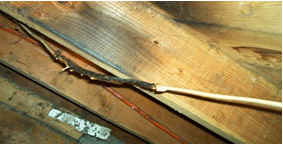
Do
you think Scott should have pointed this wiring issue to the home
owners as well as the buyers?
PS. He
did...
|
And
on the other side - Don’t believe the housing
hype
Judging by the latest real estate data, the Canadian housing market
could scarcely be better. Average home prices are up more than 16
per cent this year, and in May they hit an all-time monthly high,
according to the Canadian Real Estate Association. By those numbers,
Canada
didn’t just sidestep the housing market crash that continues to
plague the United
States,
it sailed right through it virtually unscathed. And yet, there are
plenty of signs that the Canadian housing market is still sitting on
some very shaky ground—and even the potential that Canada’s big
housing crash is yet to come.
There is one particular statistic that suggests trouble could be
brewing. Unlike in the U.S.,
Britain
and most European countries, household debt in
Canada
is, incredibly, still growing. That rising debt is being driven
largely by record low interest rates. Canadians have been buying
homes not so much because they can afford them, but because many
believe there’s never been a better time to buy, with lending rates
so low.
“There is no doubt that record low mortgage rates have juiced
Canada’s
housing market,” wrote BMO economist Sal Guatieri, in a recent
newsletter. Houses are barely more affordable now than they were
during the market peak. And as people keep buying, houses may only
become less and less affordable.
Not
everyone agrees with the CRE figures that suggest the market has
managed such a quick and painless turnaround, either. According to
the Teranet-National Bank housing price index,
Canada’s
housing market is not recovering yet. Home prices have been falling
for the past eight months, according to its latest statistics.
Vancouver,
Calgary
and Toronto
have each experienced significant price drops compared to last year.
This would seem more in line with what one would expect after an
unprecedented six-year housing boom in which home prices shot up 80
per cent.
It is, of course, possible that the correction will, ultimately, be
modest. Guatieri expects that interest rates will remain low and
income growth will remain subdued this year, before picking up next
year. That will keep housing prices down, but would likely mean the
worst of the correction is behind us.
But
if mortgage rates go up sharply then “affordability will get
crunched again,” says Guatieri, in an interview. Things could get much, much
worse. And that’s not
an unthinkable scenario. Some banks have already boosted interest
rates twice this year. Then there is the possibility that job losses
continue and the economy doesn’t recover quickly, putting further
strains on household finances. The low interest rates and continued
debt problems mean that Canadians could find them themselves badly
over-exposed.
Guatieri isn’t forecasting a housing market crash. But, as he wrote
last week, “it’s worth remembering that the further house prices go
up and the longer household finances get stretched, the greater the
risk of a painful correction. Anyone who doubts that should talk to
an American or British homeowner.”
.
Remember: If you refer us
to anyone who mentions your name when we are doing their
inspection, you will receive a $25 gift certificate to the Atlas
Cafe in Courtenay.
|